What Is Revenue Architecture and Why It Determines How Fast a B2B Company Can Scale
The gap between a $3 million business and a $15 million business is rarely product quality. It is almost always the revenue function, specifically, whether the revenue function is engineered or improvised.
Improvised revenue functions work through effort. Deals close because a skilled salesperson worked them. Customers retain because an account manager remembered to check in. Revenue grows when the right people have a good quarter. The problem is not that this approach fails. It often works well up to a point. The problem is that it cannot scale. The ceiling is set by individual capacity, not system performance.
Revenue architecture is the alternative. It is the intentional design of the entire customer lifecycle, from first contact through closed won through renewal, as an engineered process rather than a sequence of human decisions. When revenue architecture exists, performance becomes predictable. Onboarding new resources works. Forecasting is accurate. Growth compounds rather than oscillating. This is what separates businesses with functioning [revenue operations](/capabilities/revenue-architecture) from those still running on founder instinct.
Why Revenue Growth Gets Harder as Companies Scale
Most businesses build their revenue function reactively. A CRM gets set up to track deals. Salespeople are hired without a defined process to train them on. Marketing sends leads to sales but has no visibility into what happens after the handoff. Customer success is managed separately from everything else.
At $1 to $3 million in revenue, this works. The founding team knows every customer. The CEO compensates personally for absent processes. Deals close through network effects and reputation. There are few enough moving parts that informal coordination holds.
By $5 to $10 million, the cracks appear. New salespeople underperform relative to early hires. Customer success gets overwhelmed as the account base grows. Marketing and sales argue about lead quality. The CEO is still needed in too many closes. Revenue growth slows disproportionately relative to the headcount being added.
The root cause is not effort. Most teams at this stage are working hard. The root cause is structural: the revenue function was never designed as a system. When the founding team was small enough to compensate informally, this was invisible. As the organization grows, the absence of architecture becomes the constraint.
Why CRM Implementations and Agency Hires Do Not Solve This
The default response to a stalling revenue function is tactical: hire another salesperson, implement a new CRM, run a refreshed ad campaign. These moves miss the diagnosis.
A CRM configured without an underlying sales process does not create process. It documents chaos. The stages do not reflect actual buying behavior. The data entered is inconsistent. Reports tell you what is in the funnel, not how to improve it.
Additional salespeople hired into an undocumented process do not outperform. They inherit the dysfunction. Without qualification criteria, deal-stage logic, or playbooks, new reps rely on personal instinct, which varies widely, producing unpredictable results.
The fundamental issue is that revenue architecture cannot be delegated to a software tool or resolved by adding headcount. It requires deliberate design of the entire customer lifecycle with clear logic defining how movement through that lifecycle is triggered, measured, and optimized.
What Revenue Architecture Actually Is
Revenue architecture is the end-to-end design of the system that converts market attention into closed revenue and then retains and grows it. It treats the customer lifecycle as an engineering problem rather than a management problem.
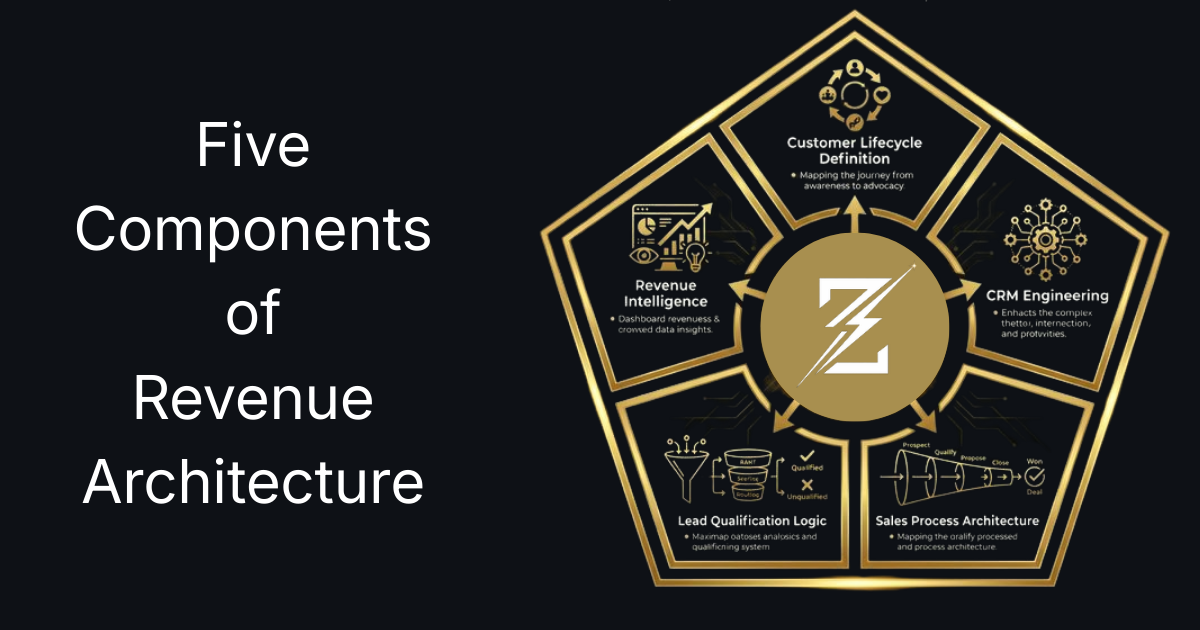
Five components make up a complete revenue architecture. The first is customer lifecycle definition, mapping every stage from first awareness to closed won to renewal with documented entry and exit criteria for each stage. This is not a CRM configuration task. It is a strategic design exercise that requires input from sales, marketing, and customer success.
The second component is CRM engineering. Once the lifecycle stages are defined, the CRM is configured to enforce them: stage automation, transition triggers, activity logging requirements, and the alerts that prompt the right action at the right time. Most CRMs are underutilized because they are configured before the process they are meant to enforce has been designed.
The third component is sales process architecture. The specific conversations, content, and actions required at each deal stage. Not a rigid script but a documented playbook that captures the logic of the highest-performing closes and makes them transferable to the full team.
The fourth component is lead qualification logic: the scoring and routing rules that ensure sales resources focus on opportunities most likely to close at acceptable margins. Without this, sales teams waste significant time on leads that were never going to convert.
The fifth component is revenue intelligence: the dashboards and review cadences that give leadership real-time visibility into pipeline health, stage conversion rates, and forecast accuracy. For SaaS companies in particular, this layer is where expansion revenue and retention analytics are managed, often revealing compounding opportunities that informal tracking misses entirely.
Working through this? Talk to ZAKFN Labs →
How Revenue Architecture Gets Built
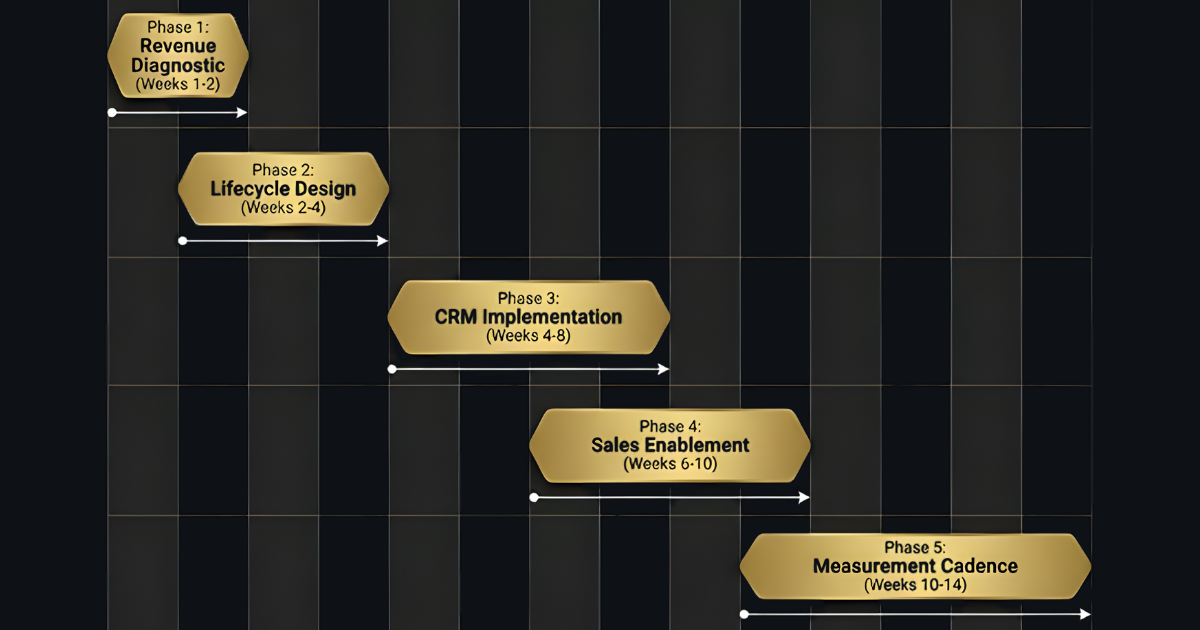
Building revenue architecture is a phased process that typically runs eight to fourteen weeks for the core implementation, with ongoing refinement thereafter. The sequence matters: each phase creates input for the next.
Phase one is a revenue diagnostic. Map every touchpoint in the current customer journey. Analyze historical close data by ICP segment, lead source, deal size, and sales rep to identify pattern, what actually predicts successful outcomes versus what the team believes predicts them. These two things are frequently different.
Phase two is lifecycle design. Define the buying stages with precision. For each stage document: what does the customer need to know or believe to advance? What action are you asking them to take? What disqualifies a prospect from advancing? These criteria become the foundation of every downstream configuration.
Phase three is CRM implementation. Configure the CRM to enforce the lifecycle design, stage logic, automation triggers, reporting views, and the data hygiene protocols that prevent the system from filling with noise. Most implementations require significant data cleanup before useful patterns can be extracted.
Phase four is sales enablement. Build the content and tools that let sales execute the defined process consistently: case studies referenced at the right deal stage, objection handling documentation, proposal templates calibrated to ICP segments, and qualifying frameworks that protect time from low-probability leads.
Phase five is measurement cadence. Establish the review rhythm and reporting structure that makes the system self-improving. Weekly pipeline reviews against forecast. Monthly conversion rate tracking by stage. Quarterly strategic resets that redirect resources based on what the data shows.
Before and After: What Revenue Architecture Changes
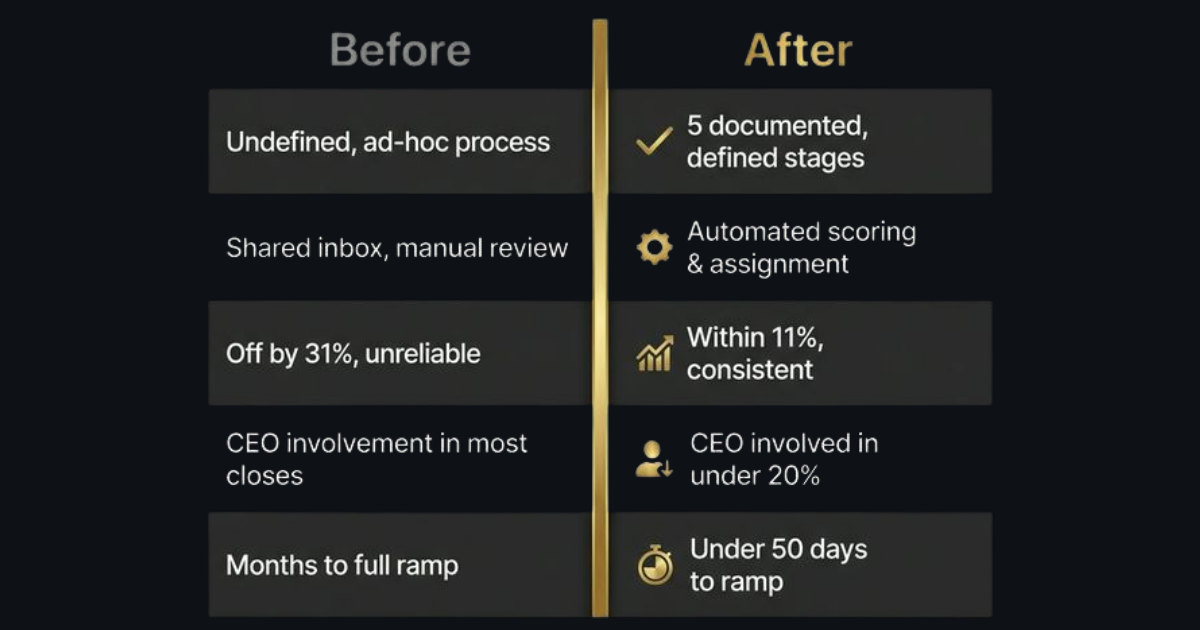
Before revenue architecture: a 22-person B2B company with $4.2 million in ARR. The CRM has nine deal stages with no documented criteria between them. Marketing routes leads to a shared inbox reviewed inconsistently. Salespeople prioritize deals based on personal judgment, not qualification logic. Win rate analysis does not run regularly. The CEO attends most significant closes. Revenue forecast accuracy in the previous four quarters: off by an average of 31 percent.
After revenue architecture, implemented over 12 weeks: five precisely defined deal stages with documented entry criteria. A 14-point lead scoring model routes qualified leads directly to the appropriate rep within four hours. A three-conversation sales framework with supporting content for each stage. Win rate analysis runs monthly and flags specific objection patterns that prompt playbook updates. The CEO reviews a pipeline dashboard weekly and attends fewer than 20 percent of closes.
Fourteen months post-implementation: ARR has grown to $6.9 million. Two salespeople have been added, both ramping in under 50 days. Forecast accuracy has improved to within 11 percent. Customer retention has improved because the sales-to-customer-success handoff now includes structured context rather than verbal briefings that vary by rep.
What Revenue Architecture Makes Possible
Forecasting accuracy improves because the system converts intuition into measurable conversion rates at each pipeline stage. Investment and hiring decisions become less speculative. When you know your stage conversion rates and average deal velocity, you can predict revenue outcomes from current pipeline with genuine reliability.
Sales performance becomes more consistent across the team. Top performers are no longer outliers whose methods are opaque. Revenue architecture captures the logic of the best closes and makes it transferable. Average performance lifts because new reps are trained on documented best practices rather than observational learning from whoever sits nearby.
Marketing efficiency improves when revenue operations provides systematic feedback on which lead sources produce the highest stage conversion rates. This redirects budget toward what actually closes rather than what generates the most top-of-funnel volume. A shift that consistently lowers blended CAC significantly. This is where performance marketing and revenue architecture intersect: the data produced by a well-instrumented CRM tells you which paid channels are producing the best qualified pipeline.
For SaaS companies specifically, revenue architecture enables the retention and expansion analytics that determine whether the business is building a healthy recurring base or running a leaky bucket. The visibility into cohort behavior that architecture provides often reveals expansion opportunities that informal systems miss entirely.
When Revenue Architecture Is Premature
Revenue architecture requires sufficient historical data to design from. If a business has fewer than 30 to 50 completed customer deals, there is not enough signal to engineer a process reliably. In early stages, the priority is reaching sufficient volume through whatever works, even if the approach is manual and inconsistent. Architecture comes after pattern.
The other scenario where architecture is premature is when the core commercial model is still in flux. If the ICP is being redefined, the pricing model is changing, or a new product is being introduced to market, building infrastructure for the current selling motion risks obsolescence before the implementation is complete. Architecture built on a stable model has a long useful life. Architecture built on a shifting one needs constant rebuilding.
Revenue architecture is a significant organizational commitment. It requires willingness to change how the revenue function operates, including in areas where senior people have relied on personal judgment for years. That willingness is a precondition, not an outcome of the process. If you are still building the demand side of your business, start with growth infrastructure before engineering the revenue layer.
Next step
Engineer the Revenue Function
Most B2B companies reach a revenue ceiling that effort alone cannot break through. The solution is not more effort. It is better architecture. [ZAKFN Labs](https://zakfn.com) builds revenue systems for companies at the inflection point between founder-led sales and scalable revenue operations. If that describes where you are, start with our contact page.
Start the Conversation