What Is Growth Infrastructure and Why Most Businesses Are Operating Without One
Most revenue problems are not marketing problems. They look like marketing problems from the outside. The pipeline is thin, conversions are slow, growth has stalled, but trace the root cause and what you find is a structural gap. There is no reliable system underneath the business capturing, qualifying, and converting demand. What exists instead is a collection of disconnected tactics: a campaign here, a content push there, a referral network held together by one person's relationships.
That is not infrastructure. An infrastructure is a system that runs reliably without constant intervention. Growth infrastructure is the deliberate engineering of demand generation, lead qualification, and revenue conversion into a coordinated operating system, one that produces compounding results rather than resetting with each campaign cycle.
This distinction matters more than most founders and operators acknowledge. Companies without growth infrastructure cannot forecast revenue accurately, cannot onboard new resources effectively, and cannot escape the key-person dependency that limits most businesses before they reach their potential.
Why Revenue Stagnation Is an Architectural Problem
When growth stalls, the default diagnosis is a demand problem. Not enough visibility. The wrong message. Insufficient ad spend. So companies spend, on agencies, campaigns, new tools and frequently see little return. Not because the spend is wasted on bad tactics, but because the problem is structural and tactics alone cannot fix structure.
The underlying issue in most stagnant businesses is the absence of a system connecting demand generation to revenue conversion. Attention gets generated by one team with one set of tools. Leads land in a shared inbox. A salesperson works the ones that feel right. Some close. Some disappear. Nothing is measured at the stage level. There is no feedback loop improving the system over time.
When growth happens despite this, it is driven by individual heroics rather than system performance. The best salesperson pulls the number. The founder's network delivers referrals. A campaign spike inflates a quarter. None of it is repeatable or scalable because none of it is infrastructure.
Why Agencies, New Hires, and Tools Fail to Fix This
The intuitive response to a growth problem is to add resources. A marketing agency, an additional salesperson, a new CRM. These moves are not inherently wrong. But applied to a business without underlying infrastructure, they compound the problem rather than resolving it.
An agency running campaigns without a defined lead qualification process generates expensive, unworked leads. A new salesperson hired into an undocumented sales process learns from inconsistent examples and performs inconsistently. A CRM configured without a defined pipeline logic becomes a data landfill rather than a revenue forecasting tool.
Resources applied to a broken system do not fix the system. They produce more output from a process that was already producing the wrong kind. This is why companies can spend significant budget on agency retainers and see flat results over 12 months. The problem was never execution capacity. It was the absence of a coordinating system underneath the execution.
What Growth Infrastructure Actually Consists Of
Growth infrastructure is not a software platform or a single discipline. It is the deliberately designed combination of process, technology, and content that runs a company's revenue function as a coherent operating system.
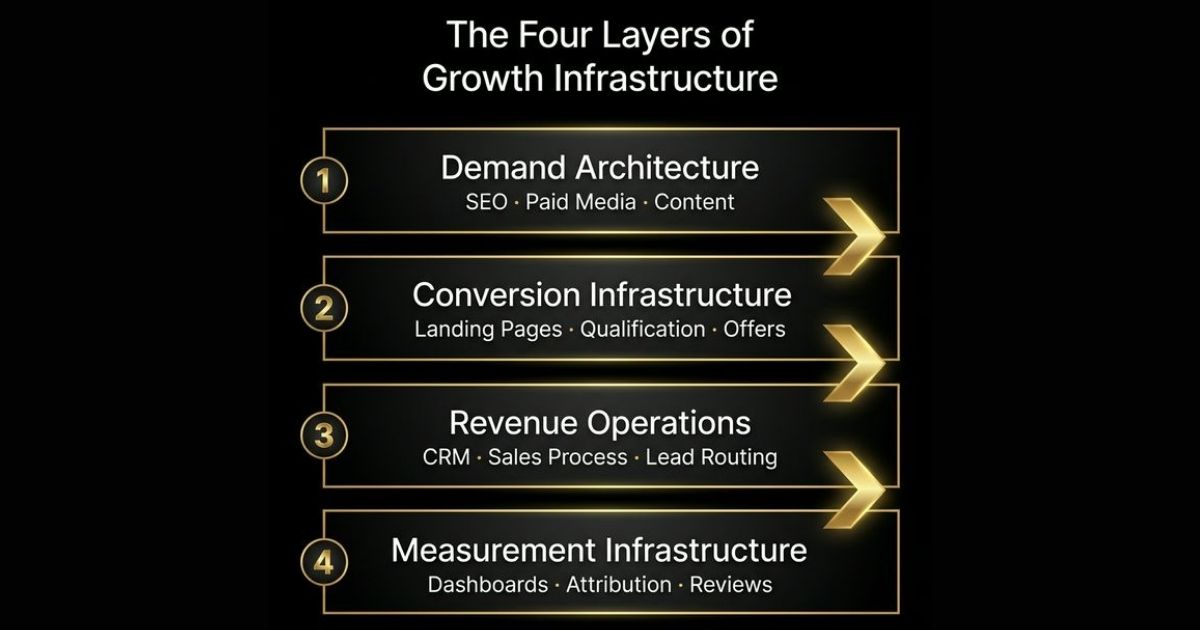
The first layer is demand architecture. The channels, content systems, and targeting logic that surface the business in front of qualified buyers consistently. This includes the SEO systems that capture high-intent search queries, paid acquisition configured for ICP targeting, and the content engine producing expert material that builds category authority over time.
The second layer is conversion infrastructure. The landing pages, offer structures, qualification flows, and nurture sequences that convert attention into pipeline. Most businesses have weak conversion infrastructure. The gap between attention generated and leads qualified is where significant revenue is lost quietly.
The third layer is revenue operations. CRM engineering, sales process documentation, lead routing logic, and the handoff mechanisms between marketing and sales. Without this layer, qualified leads fall through cracks, pipeline visibility is poor, and forecasting is guesswork.
The fourth layer is measurement infrastructure, dashboards, attribution models, and review cadences that give leadership real visibility into what is working, what is not, and where to allocate resources next. This layer is frequently absent or misleading. Businesses measure vanity metrics rather than the stage-level conversion rates that actually predict revenue outcomes.
Working through this? Talk to ZAKFN Labs →
How to Build Growth Infrastructure Systematically
Building growth infrastructure is a phased engineering process. It typically takes three to six months to establish the core layers, with ongoing optimization thereafter. The sequencing matters because each phase creates the foundation the next depends on.
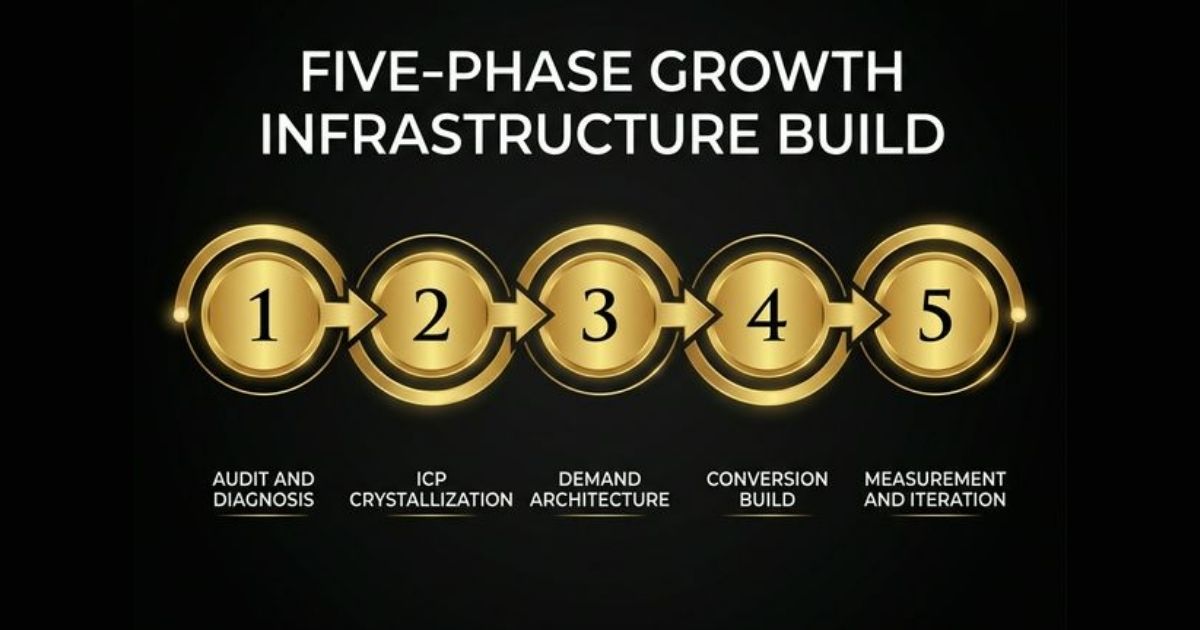
Phase one is audit and diagnosis. Before building anything, map every channel, tool, process, and handoff point in the current revenue function. The audit surfaces structural gaps, stages where demand is generated but not captured, leads that are qualified but not worked, pipeline that is tracked but not acted on.
Phase two is ICP crystallization. Every infrastructure decision depends on a precise account of the ideal customer. Not a demographic sketch. A behavioral and economic profile identifying which customers close fastest, retain longest, refer most, and require the least margin-eroding support. The ICP drives every subsequent build decision.
Phase three is demand architecture design. Using the ICP as the foundation, configure the channels and content systems that generate qualified attention consistently. For most B2B companies this means an organic search presence targeting high-intent queries, a content distribution system, and at least one paid acquisition layer for near-term pipeline.
Phase four is conversion infrastructure build. Design and deploy the landing pages, qualification flows, offer structures, and follow-up sequences that convert incoming attention into bookable leads. This includes CRM configuration and lead routing logic that ensures no qualified prospect is lost to slow or absent response.
Phase five is measurement and iteration. Establish the dashboards and review cadences that make the system self-improving. The goal is not a set-and-forget system. It is a system that gets measurably better each quarter based on what the data shows.
A Before and After: Growth Infrastructure in the Real World
Consider a professional services firm with eight consultants and a founding partner who handles all new business development. Revenue has been roughly flat for two years at $2.8 million. The firm gets clients through the partner's network and occasional referrals. Past agency engagements have not produced sustained results.
The root cause is visible: the firm has no demand architecture independent of the partner. When the partner is not actively networking, no new business enters the pipeline. There is no content system establishing the firm's expertise publicly. There is no search presence capturing the intent of buyers actively evaluating firms with their capabilities.
With growth infrastructure in place. A topical SEO system targeting the specific queries their buyers research before engaging, a LinkedIn content engine distributing the partner's insights without requiring daily personal effort, a qualification flow capturing and routing inbound website interest. The picture changes materially. Fourteen months later, inbound through organic channels accounts for nearly a third of new revenue. The partner still closes business but is no longer the sole source of it. Revenue has grown to $3.9 million without adding a salesperson.
What Becomes Possible When Infrastructure Is in Place
The first change is predictability. When the revenue function runs on infrastructure, forecasting becomes possible. You know that your demand architecture generates a certain volume of qualified attention, that your conversion infrastructure captures a defined percentage as leads, that your revenue operations closes a known fraction to deals. The chain is visible, measurable, and manageable.
The second change is leverage. Infrastructure amplifies every additional resource you add to the business. A new salesperson hired into a functioning revenue operations layer ramps in weeks rather than months because process and tooling are in place. Additional ad spend applied to a working demand architecture scales without breaking. A content hire feeds a distribution system that already has an audience.
The third change is compounding. Infrastructure builds value over time in ways that campaign approaches do not. Revenue architecture matures and becomes more effective with historical data. An SEO system accumulates ranking positions and domain authority. A content library grows in depth. The returns in year two are higher than year one, without resetting the investment every quarter.
Who Should Not Start With Infrastructure
Growth infrastructure requires two preconditions: a validated offer and financial stability sufficient to support a build period. If a business is still iterating on what it sells, to whom, and at what price. If customer feedback is mixed and retention is poor, infrastructure is premature. Building a demand architecture for an offer that customers are not reliably buying produces expensive evidence of a product problem, not growth.
If the immediate constraint is cash, infrastructure is also the wrong priority. The compounding returns materialize over time. A business with three to four months of runway and declining revenue needs direct outbound, rapid proposal cycles, and immediate closes, not a six-month infrastructure build. Infrastructure is the next step once survival is no longer the primary question.
Once those two conditions are met, offer validated, financial stability established, infrastructure is not optional. Without it, growth becomes progressively more dependent on key individuals who eventually leave, burn out, or redirect their attention. The ceiling arrives sooner than most operators expect. For how this connects to your commercial layer, see Revenue Architecture Explained.
Next step
Build the System, Not the Next Campaign
If your revenue function runs on effort rather than system, where growth stops when the key people stop pushing. The problem is architectural. [ZAKFN Labs](https://zakfn.com) designs and implements growth infrastructure for companies that are ready to build what lasts. The conversation starts on our contact page.
Start the Conversation