How to Build AI Systems That Actually Replace Manual Work in Your Business
The businesses that scale most efficiently over the next decade will not be the ones that hire the most people. They will be the ones that build the best systems, specifically, systems that use automation and intelligent tooling to handle work that currently requires human time and attention.
This is not a prediction about the future. It is a description of what is already happening in the companies that are growing fastest. They are not running larger teams. They are running smarter operations with layers of automation handling the work that used to require proportional headcount.
Most businesses have not reached this point, not because the technology is unavailable, but because operational automation requires disciplined process definition before any tool can be effective. The failure mode is consistent: companies attempt to automate before they have defined what they are automating, and the results disappoint. The technology is not the problem. The absence of process design before automation is. This is the core of what [ZAKFN Labs](https://zakfn.com) addresses when building [AI automation systems](/capabilities/ai-automation-systems) for growing businesses.
Why Operational Costs Scale Faster Than Revenue in Most Businesses
In most businesses, the cost of operations scales roughly in proportion to revenue. More clients means more account managers. More leads means more salespeople. More content means more writers. The model works until the margin compression becomes untenable, typically somewhere between $3 and $10 million in revenue depending on the industry.
The structural problem is that most knowledge work is not being done by the most efficient possible resource. Skilled people spend large fractions of their time on tasks that are repetitive, rule-based, and interruptive, reporting, formatting, routing, following up, qualifying, scheduling. These are not high-judgment activities. They are high-frequency ones that consume disproportionate attention.
When these tasks are handled by automation, skilled people can focus on the work that genuinely requires their judgment: strategic decisions, relationship management, creative problem solving, quality review. The output per person increases dramatically without asking them to work harder.
Why Most Automation Attempts Fail
The most common failure mode in operational automation is automating a broken process. A chaotic lead routing workflow, automated, becomes a chaotic automated workflow. A poorly defined reporting process, automated, generates reports that nobody reads faster. Automation does not fix process problems. It amplifies whatever is underneath.
The second failure mode is tool selection before process design. Companies purchase automation platforms, workflow tools, AI writing assistants, CRM automation modules, without first defining the specific process the tool should automate. The result is purchased capability that is never deployed effectively because the underlying process was never designed.
The third failure mode is failure to account for exceptions. Every automated system encounters edge cases, inputs it was not designed to handle. Systems built without exception handling become brittle. One unusual case causes failures that propagate through downstream processes. Robust automation requires deliberate exception design, not just happy-path design.
How to Identify What Should Be Automated
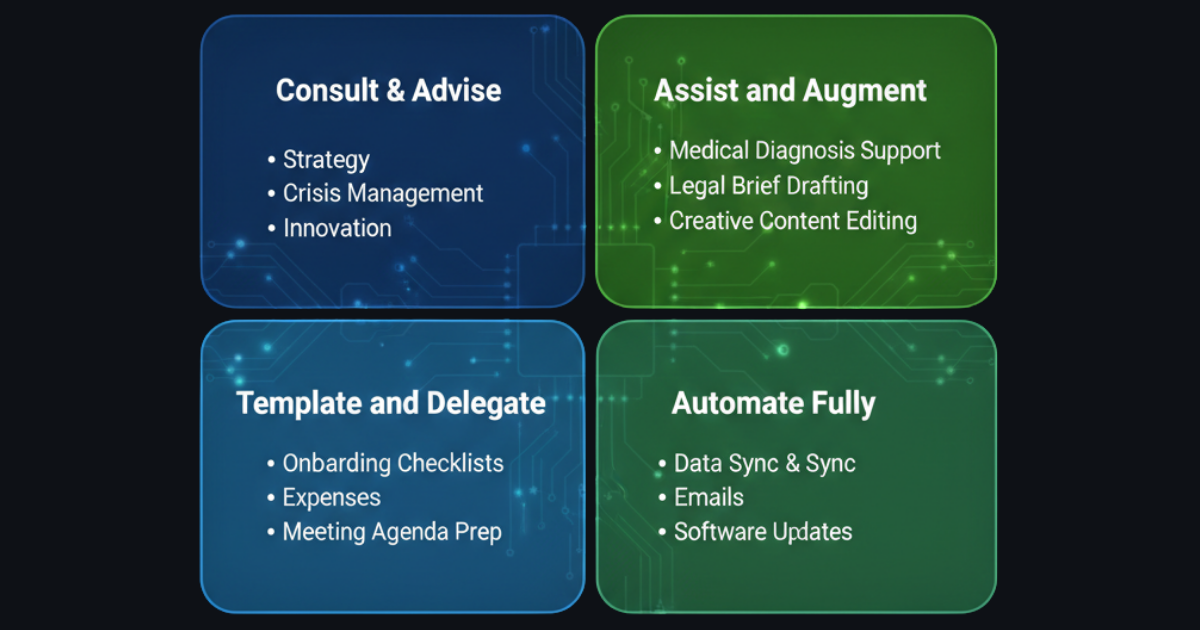
Not every process should be automated. The selection criteria matter. The highest-value automation targets share four characteristics: they are high-frequency, they are rule-based with clear decision logic, they are currently consuming skilled-person time, and they have measurable outputs that can be quality-checked.
Lead qualification is a strong candidate. If a business receives significant inbound inquiry volume, the routing and initial qualification of those leads follows clear rules, company size, industry, stated need, budget signals, that can be codified into scoring logic without losing accuracy. A skilled salesperson should not be spending two hours per day determining which leads meet the qualification threshold.
Reporting and analytics compilation is another high-value target. Most recurring reports in a business are the same data pulled from the same sources formatted the same way every week or month. Automating this frees analytical talent for interpretation rather than data assembly.
Client onboarding workflows, proposal generation, follow-up sequences, and scheduling coordination are further strong candidates. The common thread is rule-based repetition that does not require fresh judgment at every instance.
Working through this? Talk to ZAKFN Labs →
Building an Automation System That Actually Works
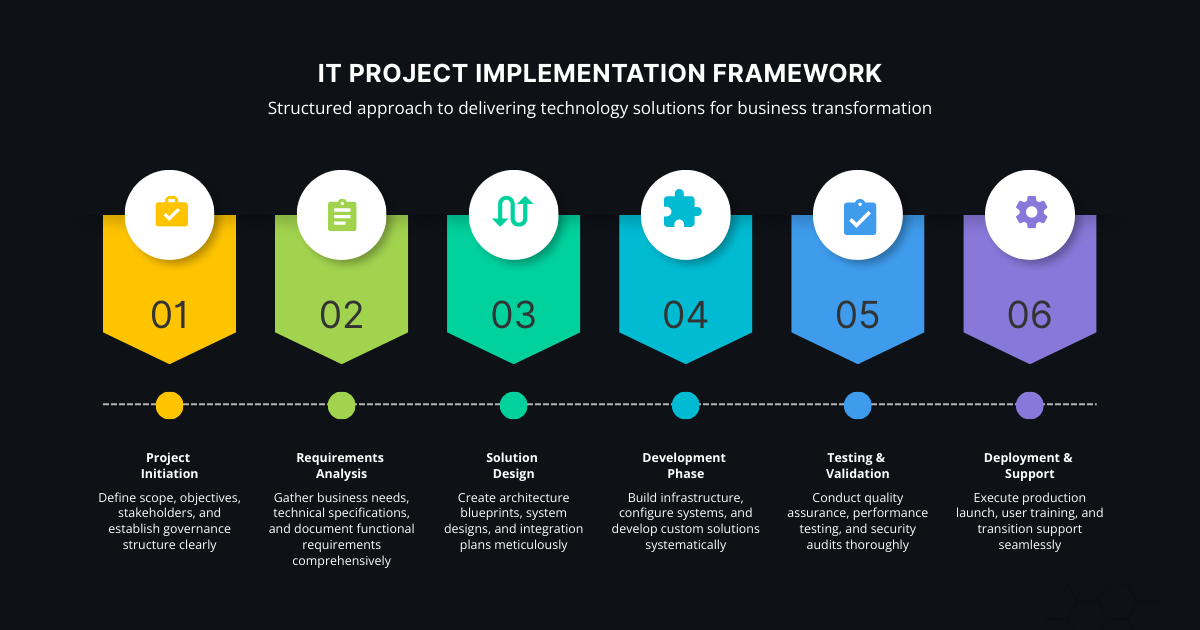
The first step is workflow audit. Before any tool selection occurs, map the existing manual process in detail: what triggers it, what decisions get made, what information flows where, what the output looks like, and where exceptions occur. This audit typically reveals redundancies and ambiguities in the process that would make automation unreliable if implemented as-is.
The second step is process refinement. Fix the process before automating it. Resolve the ambiguities. Define the exception handling logic. Clarify the output quality standards. The automation is only as good as the process definition it executes.
The third step is solution architecture. Select the tool stack based on the process requirements, not the other way around. For most business automation use cases, the relevant options are workflow orchestration platforms connected to existing business systems. The selection criteria are integration depth with existing tools, exception handling capability, and maintainability by the team operating the system.
The fourth step is build and test. Implement the automation against the defined process, test it against real historical inputs including edge cases, and validate that the outputs meet quality standards before deploying to live operations.
The fifth step is human-in-the-loop design. For any automation handling consequential outputs, client communications, financial decisions, routing that affects deals, build review and override mechanisms that allow qualified humans to catch and correct errors before they propagate. The goal is not to remove humans from consequential decisions. It is to remove humans from the repetitive work that surrounds those decisions.
What This Looks Like Across Different Operations
A recruiting firm receiving 200-plus applications per week for client roles was spending 14 hours per week on initial resume screening. A purely rule-based activity applying the same qualification criteria to every application. With an automated screening and scoring system integrated into their ATS, initial qualification now runs without human involvement. Recruiters spend their time on conversations with qualified candidates rather than on document review.
A SaaS business with a high volume of inbound trial signups was relying on SDRs to manually follow up with every trial user. Connecting this automation to revenue operations amplifies the impact significantly — qualified trial users flow directly into a structured sales process rather than a generic queue. Response time varied from hours to days depending on SDR workload. An automated qualification and outreach sequence, triggered by in-product behavior signals, now handles initial follow-up within minutes of the relevant signal. SDRs engage with trials that the automated system has already identified as high-intent. Conversion from trial to paid has improved.
A consulting firm was compiling the same client performance report from four different data sources every week. A three-hour manual process per client. An automated data pipeline and report generation system now produces the same reports in minutes. Consultants spend the time they recovered on analysis and strategic recommendations rather than data assembly.
The Strategic Compound Effect of Operational Automation
The first-order effect of automation is cost efficiency. Tasks that consumed skilled-person hours now run at fractions of the cost with greater consistency. Operational leverage improves, revenue per employee increases without requiring more from individuals.
The second-order effect is quality improvement. Automated processes execute consistently. They do not have off days, do not skip steps when busy, and do not interpret rules differently depending on mood or experience level. For high-frequency, rule-based work, automated execution is often more reliable than human execution.
The third-order effect is data accumulation. Automated systems create structured records of every execution, input, and output. This data becomes the foundation for continuous improvement, identifying where the process produces suboptimal outputs, where exceptions cluster, and where the rules need refinement. Businesses running manual operations lose this data because the work happens in people's heads and inboxes.
For SaaS businesses specifically, operational automation creates the infrastructure that allows customer success to scale without proportional headcount growth, one of the most important drivers of improving net revenue retention as a company grows beyond its initial account base.
When Automation Is the Wrong Priority
Automation is the wrong investment when the processes being considered for automation have not yet stabilized. Startups in early product iteration frequently change how they handle customer onboarding, lead qualification, and reporting as they learn about their market. Building automation on top of processes that are actively changing produces systems that need constant rebuilding. Automate after the process is proven, not while it is still being figured out.
Small teams with low transaction volumes also frequently over-invest in automation relative to the time savings generated. If a task occurs twice a week and takes 20 minutes, the automated version saves 40 minutes per week. Building a reliable automation system for that task might take 20 to 40 hours. The payback period is long. The better investment is a checklist and a template. Automation is for high-frequency processes where the cumulative time savings justify the build investment.
Next step
Build Operations That Scale Without Linear Headcount Growth
The businesses that scale most efficiently in the next decade will be those with the best operational infrastructure, not the largest teams. [ZAKFN Labs](https://zakfn.com) builds automation systems for growing businesses that want to increase output without proportional cost increases. If operational leverage is the next constraint you need to solve, read [Conversion Engineering](/insights/conversion-engineering-vs-cro) to see how automation connects to your conversion layer, or start the conversation on our contact page.
Start the Conversation